

Best Heavyweight Hoodies for Men: 2026 Buying Guide
Table of Contents
- What Separates the Best Heavyweight Hoodies for Men
- Heavyweight Hoodie GSM and Fabric Weight Explained
- Fabric Composition, Fleece Lining and Stitching That Last
- Pullover vs Full-Zip: Which Style Fits Your Rotation
- Finding an Oversized Heavyweight Hoodie for Men
- Durable Hoodies for Men: What to Check Before You Buy
- How to Wash a Heavyweight Hoodie Without Shrinking It
- Conclusion
- Frequently Asked Questions
Last Updated: October 21, 2026
What Separates the Best Heavyweight Hoodies for Men
The best heavy weight hoodies for men share three traits: substantial fabric weight, dense construction that resists pilling, and a cut that holds shape through repeated washing.
Weight without construction is just a heavy garment that sags by month three.
Most buying guides rank hoodies by thickness alone.
So learn to read the spec sheet: fabric weight, composition, stitch density, and shrinkage behavior separate a genuine wardrobe staple from a fast-fashion imitation.
Heavyweight Hoodie GSM and Fabric Weight Explained
Ounces per square yard is the older imperial measure common on US product pages; a 14 oz hoodie is broadly comparable to one around 475 GSM.

Weight predicts three things at once:
- Warmth and insulation for cold-weather wear
- Drape and structure, since heavier fleece hangs instead of clinging
- Durability, because denser loops resist pilling
There's a ceiling, though. Past roughly 500 GSM you get a garment that's stiff, slow to dry, and awkward for layering. For most people, the sweet spot for a year-round men's hoodie is 400-480 GSM.
Textile Exchange's materials and fibre standards publishes guidance on fibre measurement and composition that's worth reading if you want the technical background.
Fabric Composition, Fleece Lining and Stitching That Last
Cotton-polyester blends dominate heavyweight fleece: cotton supplies softness and breathability, polyester adds shape retention and shrinkage resistance.
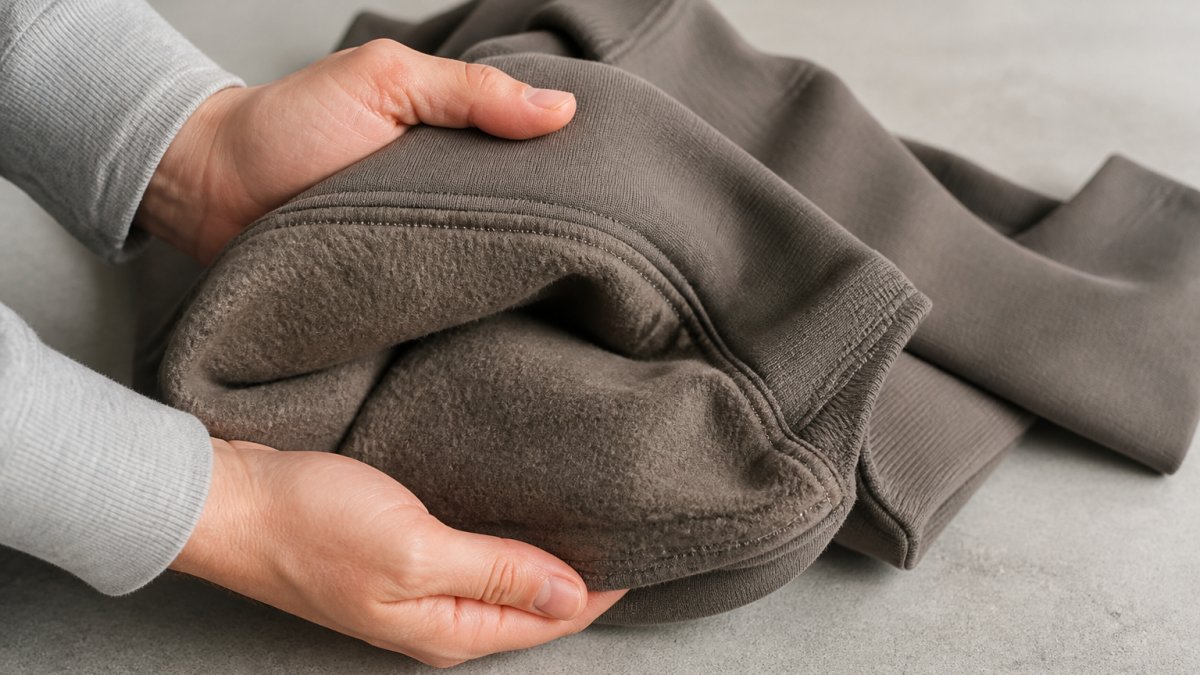
The brushed interior is where comfort lives: cheap brushing pills within weeks, while proper brushing on tightly knit fabric stays smooth through many washes.
Then there's construction. Check these points before buying:
- Cross-grain construction on the body panels, which stops the garment twisting after washing
- Double-layer hood, so it stands up instead of collapsing flat
- Ribbed cuffs and hem with enough elastane to recover their shape
- Reinforced stitching at stress points: pocket corners, hood seams, side splits
- Seam strength at the shoulders, where a heavy hoodie carries most of its load
Run your thumb along the inside shoulder seam: a single row of loose stitching will split within a year of regular wear.
Pullover vs Full-Zip: Which Style Fits Your Rotation
Pullover hoodies win on simplicity and warmth. With no zip breaking the front panel, the kangaroo pocket sits flush and the silhouette stays clean. They layer well under a jacket, which is why we favor them for everyday wear.
Full-zip hoodies win on versatility: open them for temperature control, wear them over a tee in mild weather, remove them without disturbing your hair or glasses.
Here's the honest breakdown:
| Feature | Pullover Hoodie | Full-Zip Hoodie |
|---|---|---|
| Warmth retention | Higher, no front gap | Slightly lower |
| Layering flexibility | Moderate | High |
| Silhouette | Cleaner, more structured | More casual, sportier |
| Durability of front panel | Stronger | Depends on zip quality |
| Best for | Cold weather, minimalist looks | Transitional seasons, gym-to-street |
For a first heavyweight hoodie, pick the pullover. It's more forgiving of fit and shows fabric quality more clearly. Add a full-zip once you know your size in a brand.
The construction details that actually decide the style
At the same fabric weight, four construction points separate a pullover from a full-zip.
- Front-panel integrity. A pullover's front is a single continuous panel, so it resists twisting through repeated washing. A full-zip splits that panel into two pieces joined by zipper tape, which is why cheap zips pucker at 400+ GSM. Look for a metal slider and a tape that lies flat against the fleece.
- Hood attachment. A pullover's double-layer hood stands up on its own. A full-zip's hood is split by the zip and collapses more easily unless the brand adds a structured panel or higher collar. Try it on and check whether it stays upright without your hands.
- Pocket design. A pullover kangaroo pocket is a single piece of fabric sewn at the sides, which distributes load well. A full-zip uses two separate hand pockets or a split kangaroo, and the corners are a common failure point. Single-stitch corners split first.
- Hem and cuff recovery. Both styles rely on ribbed cuffs and hem with enough elastane to snap back. A full-zip's hem carries more stress, so check that the ribbing is continuous across the front opening rather than pieced.
Match the style to climate and activity, not just preference
The pullover-versus-zip decision should follow how and where you'll wear it.
- Cold, dry winters and low activity: A pullover at 450-480 GSM traps heat across a continuous front panel and is the warmer choice for standing around or commuting.
- Transitional seasons and variable temperatures: A full-zip lets you vent without removing the layer when moving between heated interiors and cold streets.
- Layering under a jacket: A pullover adds less bulk at the front and slides under a coat more cleanly.
- Gym-to-street and post-workout: A full-zip is easier to pull on over a tee when you're warm and easier to open as you cool down.
- Humid or mild climates: A 400-420 GSM full-zip worn open gives you more control than a heavy pullover you have to take off entirely.
Finding an Oversized Heavyweight Hoodie for Men
Oversized heavyweight hoodies for men work only when the fabric has enough body to hold the shape. Light fleece in an oversized cut looks baggy; heavy fleece looks intentional.
Fit guidance varies by body type and layering needs:
- Between sizes? Size down for a relaxed fit, up for a true oversized look. Heavier fabrics don't stretch into place the way lighter knits do.
- Broad shoulders: Check the shoulder-to-shoulder measurement, not just chest width. Dropped shoulders on an oversized cut add visual width.
- Layering over a shirt: Allow roughly a finger's width of ease at the chest so the hoodie doesn't pull across the back.
- Shorter frames: Look for a cropped or standard-length body. An oversized hoodie that runs long will swamp the silhouette.
Ask for a sizing guide with flat-lay measurements before ordering. Chest width, body length, and sleeve length from the shoulder seam tell you more than S/M/L labels.
ESSENTIALS FEAR OF GOD HOODIE SS22 →
Durable Hoodies for Men: What to Check Before You Buy
Durable hoodies for men come down to checks you can run in under two minutes in a store or on a product page. "Good stitching" and "quality fabric" don't tell you whether a hoodie will survive twenty washes.
The four pre-purchase checks, made specific
1. Fabric weight and density. Look for a stated GSM or oz figure; no number is a red flag.
2. Stitch density. Higher stitches per inch means stronger seams.
3. Shrinkage policy. Pre-shrunk or garment-washed fabric behaves predictably. Unwashed cotton can move a full size.
4. Care instructions. A hoodie that demands cold hand-washing won't survive a real rotation. Machine-washable, cold-water care is the practical baseline for a garment you'll wear weekly.
Material and sourcing transparency is the fifth, quieter signal. Brands that publish fibre composition and construction details tend to stand behind what they sell.
A repeatable testing method you can run at home
Shrinkage test. Wash and dry the hoodie per the care label, then re-measure using the same flat-lay method.
Pilling test. After several wears and washes, inspect the underarm, the side panels where a bag strap rubs, and the cuffs. Pilling concentrates at friction points.
Seam-strength check. Gently tug the shoulder seam, pocket corners, and hood attachment point. A seam that opens under light tension will fail under real wear.
Colorfastness check. Wash a dark or saturated hoodie with a white cotton cloth or tee in the same load.
What long-term durability actually looks like
A common pattern among heavyweight hoodies is that the fabric outlasts the trims: the fleece is still thick at year three while the cuffs have stretched or the pocket corners have split. That's why the checks above weight trims and seams as heavily as fabric weight.
- Cuffs and hem are the first to go on a hoodie worn weekly. Ribbing with too little elastane relaxes permanently; look for cuffs that snap back when stretched.
- Drawcords and eyelets fail at the hood exit point. Metal eyelets outlast stitched buttonholes.
- Pocket corners take load every time you put your hands in. Reinforced bar tacks at the corners are a durability signal.
- The brushed interior flattens over time regardless of quality, but a tightly knit, well-brushed fleece stays soft far longer than a loosely brushed one.
None of this requires trusting a brand's claims. Measure, wash, re-measure, and inspect. That's the difference between a hoodie that lasts a season and one that lasts a decade.
How to Wash a Heavyweight Hoodie Without Shrinking It
Wash a heavyweight hoodie inside out in cold water on a gentle cycle, then air dry flat or hang it. Heat is what shrinks cotton and pills fleece, so keep both the wash and the dryer cool.
The full routine:
- Turn it inside out to protect the brushed interior and any print.
- Cold water, gentle cycle. Warm water accelerates shrinkage and fibre stress.
- Mild detergent, no fabric softener. Softener coats fleece fibres and flattens the pile.
- Skip the dryer, or use low heat briefly. Air drying preserves size and softness.
- Dry flat or hang from the hem. Hanging from the hood stretches the shoulders.
- Fold, don't hang, for storage. Long-term hanging distorts heavyweight knits.
Wash sparingly: heavyweight fleece doesn't need a wash after every wear, and airing it out extends its life. Expect minor first-wash shrinkage even with pre-shrunk fabric, which is why buying to a measured size beats guessing.
Conclusion
Getting a heavyweight hoodie right is mostly a matter of refusing to buy on looks alone. Check the GSM, read the composition, inspect the seams, and confirm shrinkage behavior, and you'll avoid replacing pilled, misshapen sweatshirts every year.
Our hoodies are cut for a relaxed, minimalist fit in neutral tones, made from durable fabrics, and shipped fast so you can start wearing them immediately. Browse the collection and build a rotation designed to last.

Frequently Asked Questions
How heavy should a hoodie be?
Fabric weight is measured in ounces per square yard or GSM, and it decides how warm and structured the hoodie feels. Standard hoodies usually sit in the light-to-mid range, while the best heavyweight hoodies for men start where the fabric feels substantial in the hand and holds its shape on the body. Anything too light drapes and pills faster; anything too heavy becomes a winter-only piece. Aim for a weight that matches your climate and how you plan to layer it.
What fabric makes a hoodie feel heavyweight?
Cotton and cotton-polyester blends with a brushed fleece interior give that dense, soft feel. Heavier yarns, tighter knitting and cross-grain construction add weight without stiffness. A double-layer hood and ribbed cuffs, hem and kangaroo pocket also add structure. Ask for the GSM or ounces per square yard before you buy: a heavyweight fleece hoodie should feel thick at the seam, not just soft on the surface. Composition and construction together matter more than the label alone.
Are heavyweight hoodies warmer than regular hoodies?
Yes, heavier fabric traps more warmth, which is why a heavyweight fleece hoodie works as cold-weather wear on its own. The trade-off is breathability: a very heavy hoodie can feel clammy indoors or during activity. For layering under a jacket or for casual wear in a mild office, a mid-to-heavy weight is more versatile. If you run hot, look for a brushed interior with a slightly lighter GSM rather than the heaviest option on the shelf.
How do you wash a heavyweight hoodie without shrinking it?
Turn it inside out, wash cold on a gentle cycle with a mild detergent, and skip the fabric softener, which coats the fleece. Never tumble dry on high heat; air dry flat or on a low setting to limit shrinkage and pilling. Wash with similar colors and avoid overloading the machine. Done this way, a durable heavyweight hoodie keeps its fit and brushed interior far longer, and the ribbed cuffs and hem stay tight instead of stretching out.