

How to Build a Capsule Wardrobe Basics Guide
Table of Contents
- What a Capsule Wardrobe Is (And What It Isn't)
- Start With a Wardrobe Audit and Closet Edit
- Try Everything On Before You Decide
- How Many Clothes Should Be in a Capsule Wardrobe?
- Your Capsule Wardrobe Checklist for Building the Core
- How to Choose Quality Clothing That Lasts
- Capsule Wardrobe Outfit Ideas You Can Repeat Weekly
- Conclusion
- Frequently Asked Questions
Last Updated: October 21, 2026
What a Capsule Wardrobe Is (And What It Isn't)
A capsule wardrobe is a small, intentional collection of versatile pieces that mix and match into a full rotation of outfits. At The Essentials Shop, we treat it as a working system: fewer pieces, each earning its place, all easy to wear together.
Social media fuels the confusion: people see a curated closet of beige knitwear and assume they must purge everything by Sunday. That's backwards. A capsule wardrobe filters future purchases as much as it edits what you own.
A capsule wardrobe is defined by how well the pieces work together, not by a specific number. Build one around relaxed tailoring and neutral tones, or around casual T-shirts and cotton staples.
Start With a Wardrobe Audit and Closet Edit
A wardrobe audit is a structured review of every item you own, sorted into keep, repair, store, and release piles.
Set aside two hours and pull everything out, including the in-season clothes at the back and the "maybe someday" pile under the bed.
Ask three questions of each piece:
- Has it been worn in the last twelve months?
- Does it fit right now, not after a hypothetical ten pounds?
- Does it work with at least two other things in the room?
Anything that fails all three goes into the release pile.
A common mistake is keeping items because they were expensive.
Try Everything On Before You Decide
Fit is the whole game, and it's the step most guides skip. Before anything earns a place in your capsule wardrobe, put it on. Full outfit, proper mirror, real lighting.
Try each piece with the bottoms and shoes you'd actually wear it with. Sit down in it. Reach overhead. Check the shoulders and whether the waistband digs in after five minutes.
This is especially true with relaxed fits. Oversized hoodies and relaxed sweatpants can look intentional or sloppy depending on where the volume sits, so try them on rather than guessing from a size chart.

If you're between sizes, size for the fit you want rather than the label.
How Many Clothes Should Be in a Capsule Wardrobe?
There is no universal number, and anyone who says otherwise is selling a template. A practical starting point is thirty to forty pieces total, including shoes and outerwear, adjusted for climate and laundry frequency.
The more useful question is proportion. A balanced capsule typically looks like this:
| Category | Suggested Pieces | Notes |
|---|---|---|
| Tops | 8-10 | Mix of T-shirts, long-sleeve tops, one or two smarter options |
| Bottoms | 4-6 | Pants, shorts, one relaxed sweatpant |
| Knitwear | 3-4 | Sweaters and hoodies for layering |
| Outerwear | 2-3 | One light jacket, one warmer layer |
| Shoes | 3-4 | Everyday sneaker, something cleaner, weather-appropriate pair |
| Accessories | 3-5 | Belt, bag, hat, scarf as climate dictates |
Count what you actually wear weekly rather than what looks good on a checklist. If you work in a casual office and spend weekends outdoors, your ratio should reflect that. The number of pieces matters far less than repeat wear.

Your Capsule Wardrobe Checklist for Building the Core
Use this capsule wardrobe checklist as a working document, not a shopping list to finish in one weekend. Build gradually and buy only when a genuine gap appears.
- Audit and edit your existing wardrobe
- Identify your base color: black, navy, grey, brown, or cream
- Choose two neutral colors that work with the base
- Confirm you own at least three tops that fit well
- Confirm you own two bottoms that work with those tops
- Add one mid-layer: a hoodie, sweater, or overshirt
- Add one outerwear piece suited to your climate
- Check shoes cover everyday, smarter, and weather needs
- Test five outfit combinations from what you own
- Note the gaps that testing revealed
- Buy only for those gaps, one piece at a time
That last point is where most capsules fail: people complete the checklist in a single haul, then discover half the pieces don't combine.
The 3-3-3 rule is a useful constraint here: three tops, three bottoms, three pairs of shoes should generate a workable set of outfit combinations before you add anything else.
A Tiered Plan for Different Budgets
Most capsule-wardrobe guides assume a single spending level, which is why so many readers bounce off them.
Low-cost tier: prioritize fit and fabric over labels. Fill genuine gaps without overpaying for details that don't affect wear.
Investment tier: buy for construction and repairability, not status. The question is not whether a piece is expensive but whether it can be maintained.
Whichever tier you choose, the sequence stays the same: audit, test, note the gap, then buy one piece. Budget changes what you buy, not the order in which you build.
How to Choose Quality Clothing That Lasts
Quality is not a feeling you get from a price tag.
Start with fabric weight and composition: heavier cotton knitwear holds its shape longer than thin jersey.
Then consider how the piece will age. Neutral colors in durable fabrics look better over time than trend-led prints, which is why investment pieces are usually simple ones.
Pilling is the usual complaint about premium knitwear, and it's worth understanding rather than fearing.
Care, repair, and replacement planning belong in the capsule from day one. Keep a small repair kit, reattach buttons before they disappear, and replace items when the fabric fails rather than when the trend does.
Capsule Wardrobe Outfit Ideas You Can Repeat Weekly
The test of any capsule is whether it produces outfits without effort on a Tuesday morning. These capsule wardrobe outfit ideas are built from the pieces above and repeat cleanly across a week.
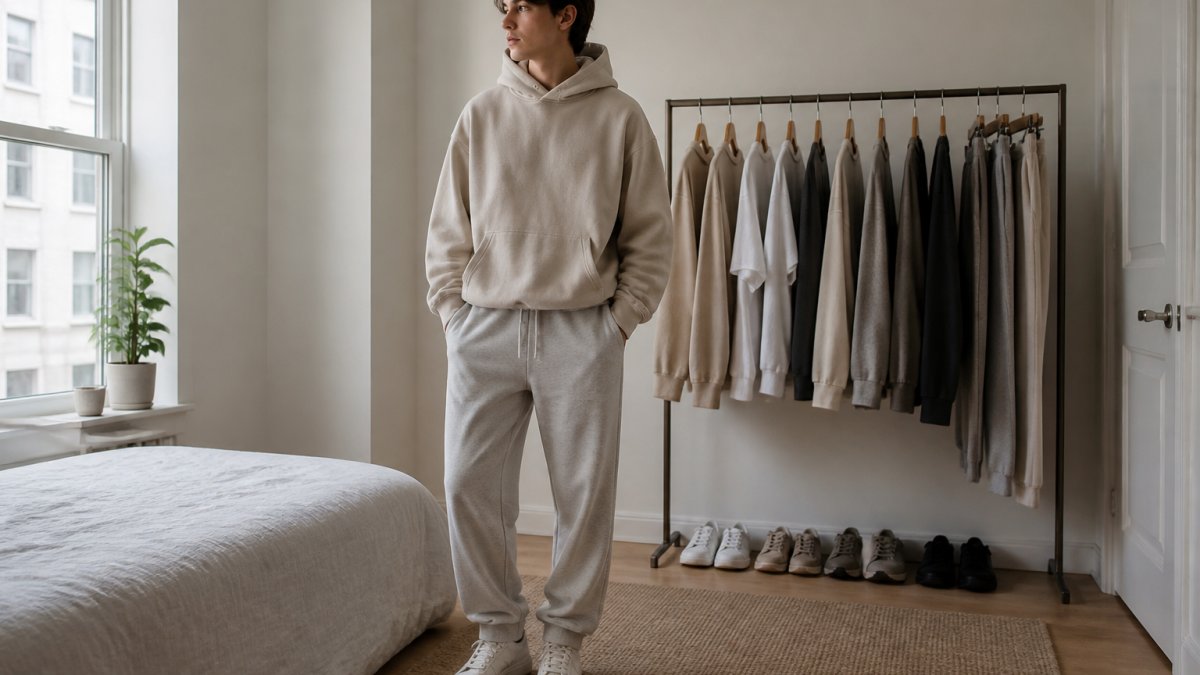
The Outfit Formulas
Each formula below uses only the categories in the checklist, tops, bottoms, knitwear, outerwear, shoes, so you can build it from what you already own.
- Formula 1, The everyday base: plain T-shirt + relaxed sweatpants or straight-leg trousers + everyday sneakers. Comfortable, neutral, and appropriate for errands, campus, or a casual office.
- Formula 2, The layered version: same bottoms + T-shirt + hoodie or sweater + light jacket. This is where layers do the work, and it is the outfit that carries you through changing seasons without new purchases.
- Formula 3, The smartened-up option: cleaner T-shirt + tailored or straight-leg bottoms + low-profile sneaker. Relaxed tailoring reads as intentional when the fit is right, which is why the try-on step matters so much.
- Formula 4, The weekend swap: shorts instead of pants + same tops and shoes. One change, whole new outfit.
- Formula 5, The cold-morning add: any of the above + a warmer outer layer and a knit scarf. The base stays the same; only the outer layer changes.
- Formula 6, The travel version: one neutral top + one bottom + one layer + one pair of shoes, all in the same color family, so every piece works with every other piece in a carry-on.
A Sample Week
Mapping the formulas across seven days shows how they work together. This isn't a rigid schedule, it demonstrates that six formulas can cover a week without repeating a full outfit.

| Day | Formula | What changes |
|---|---|---|
| Monday | Formula 1 | Base T-shirt and everyday bottoms |
| Tuesday | Formula 3 | Swap in the cleaner top and smarter bottoms |
| Wednesday | Formula 2 | Add the hoodie and light jacket |
| Thursday | Formula 1 | Same base, different color top |
| Friday | Formula 3 | Smarter bottoms again, different shoe |
| Saturday | Formula 4 | Shorts replace trousers |
| Sunday | Formula 5 | Warmer layer over the base |
Five or six formulas like these will cover most of your week. Write them down, photograph them, or keep a note on your phone. The goal is removing the daily decision, not inventing something new each morning.
Repeat wear isn't a failure of imagination. It's the point.
Conclusion
Building a capsule wardrobe is slow and deliberate, and the hardest part isn't the shopping. It's the discipline of testing what you own, buying for real gaps, and caring for pieces so they last.
We built The Essentials Shop for exactly this approach. Our oversized hoodies, relaxed sweatpants, and neutral cotton staples are designed to slot into a rotation rather than compete for attention, with durable fabrics and clean, minimal styling that survives repeat wear.
Start with the audit. Then add the one piece your wardrobe is actually missing.
Frequently Asked Questions
What is the 3-3-3 rule in minimalism?
The 3-3-3 rule is a packing shortcut: three tops, three bottoms, and three pairs of shoes, which multiplies into 27 outfit combinations. It works because each piece has to match the others, so you get range from a small set. For a capsule wardrobe, treat it as a starting framework rather than a strict limit. Add layers, outerwear, and accessories once the base three-by-three works. It is a useful way to test whether your picks actually mix before you buy more.
How many clothes should be in a capsule wardrobe?
Most capsule wardrobe plans land between 30 and 40 pieces per season, counting tops, bottoms, layers, shoes, and accessories but not underwear or gym kit. A tighter capsule of 20 to 25 pieces works if you do laundry often or live in a mild climate. The right number is the smallest set that covers your week without repeat-wearing the same outfit twice. Start at 30 and remove pieces you have not worn in a month.
What are the downsides of having a capsule wardrobe?
The main downsides are fewer spontaneous options and a higher upfront cost if you replace a lot at once. You may also get bored of the same palette, and a strict capsule can feel limiting if your work and social life need very different clothes. Build gradually instead of clearing everything out in one weekend, keep a small section outside the capsule for occasion wear, and rotate seasonal pieces so the wardrobe stays useful.
How do you choose a color palette for a capsule wardrobe?
Pick two base colors and one or two accent colors. Base colors cover most of the wardrobe: black, navy, grey, cream, or olive. Accents go on tops, knitwear, or accessories so they lift an outfit without breaking the mix. Test each new piece against at least three items you already own. If it does not combine with three, it does not belong in the capsule, no matter how good it looks on the hanger.
What are the basic items in a capsule wardrobe?
The core is usually two or three plain tees, one or two relaxed tops, two pairs of trousers or sweatpants, one pair of shorts, a hoodie or knit, a jacket, and one or two pairs of shoes. Neutral tones make these mix easily. A capsule wardrobe checklist should also include a belt or simple accessories. Add pieces in this order and you will cover casual work days, weekends, and travel without gaps.
How do I know if a garment is actually good quality?
Check four things: fabric weight, stitching, seams, and how it holds shape. Hold the fabric to the light, stretch a seam gently, and look for tight, even stitching with no loose threads. Heavier cotton and dense knits resist pilling better than thin, loose fabric. Ask for material specifics before buying, and check the return policy so you can inspect the piece properly at home rather than judging from photos.